Tuesday, August 17, 2010

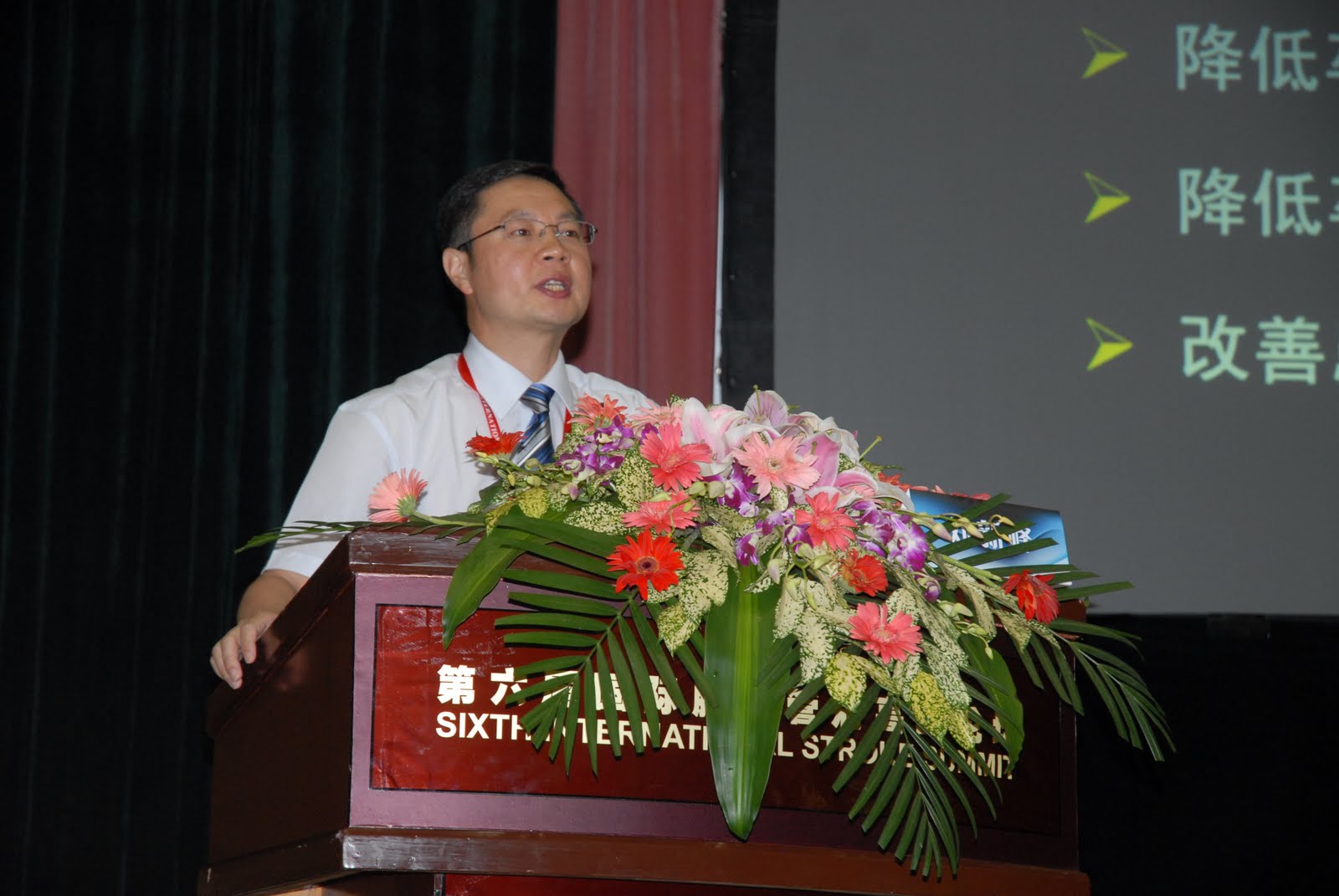
Sixth International Stroke Summit


Sixth International Stroke Summit
Juehua Zhu, Gelin Xu, Xinfeng Liu
Department of Neurology, Jinling Hospital, Nanjing University School of Medicine, Nanjing, China
Correspondence Xinfeng Liu, Department of Neurology, Jinling Hospital, Nanjing University School of Medicine, 305 Zhongshan East Road, Nanjing 21002, Jiangsu, China
To establish a platform for international communication in stroke management, Jinling hospital launched an annual conference, the International Stroke Summit in 2004. The summit has been successfully run for six times and has been endorsed by World Stroke Organization since 2007. More than 1000 doctors and researchers have participated in each meeting.
The Sixth International Stroke Summit was held on July 9-11, 2010 in Nanjing, China. The conference motif of bridging the gap between developing and developed countries in stroke management was high appropriate. Hot debate and grand attention had been focused on topics such as the development of endovascular treatment of extracranial and intracranial atherosclerotic diseases, clinical trials of stroke treatment, stroke registry and genetic factors for stroke.
On the first day of this conference, the National Neuroendovascular Association was set up. The association constitutes neurologists, vascular surgeons and intervention clinicians from major medical centers in China. The mission of such a unique association is to shed more light on the standardization of endovascular treatment in China.
Distinguished from the previous meetings, two sections specialized on endovascular therapy and an international discussion was established. In the intervention section, clinicians talked about their own experiences with cerebral angiography and stenting. In the international section, stroke specialists from America, Australia, Finland, Netherlands, Japan, India, Brazil and China shared the latest developments in stroke research.
Prof. Xinfeng Liu, the chairperson of this summit, introduced the frontier of neuroendovascular treatment. He mentioned that IV-tPA can be beneficial for acute ischemic stroke up to 4.5h from stroke onset. However, due to low recanalization rate and high re-closure rate after thrombolysis, especially in patients with severe stroke and patients with T-shaped artery occlusion, few patients who meet the criteria for IV tPA thrombolysis can benefit from it. For these patients, intra-arterial thrombolysis, mechanical thrombectomy may be the better treatment choice. Dr. Liu also introduced the recently published CREST study1. Younger patients would benefit more from carotid stenting, older patients from endarterectomy. The CREST study proved carotid artery stenting together with endarectomy to be powerful weapons against stroke.
Dr. Yongjun Wang from Tiantan Hospital lectured on the improvement of stroke management worldwide. He introduced the GWTG-stroke program carried out in USA which raised the percentage of patients receiving standard treatment under stroke guidelines; from 41% in 2003 to 83% in 20092. This study underlined the importance of guidelines in stroke treatment. In the Canadian Stroke Strategy and British National Stroke Strategy, the importance of patient education, primary prevention, pre-hospital management, acute stroke units and subacute rehabilitation units as well as secondary prevention were highlighted. Dr. Wang said stroke management in China lagged far behind than that in these western countries. The ongoing Golden Bridge Project of Stroke Care is a first attempt in China at a national public health campaign; hopefully this project will be active throughout China in the next five years.
Dr. Yukito Shinohara, a principal investigator of the Cilostazol Stroke Prevention Study (CSPS), introduced a clinical trial for stroke prevention (CSPSII). CSPSII is a randomized, multicenter, double-blind, parallel-group study, included 2757 non-cardioembolic stroke patients from 278 centers between December 2003 and December 2008. Patients randomized to cilostazol group (1337 patients), received 100 mg twice daily and aspirin group (1335 patients), received 81 mg once daily. The duration of treatment lasted a minimum of one year and a maximum of five years. Eighty-two strokes occurred in cilostazol-treated patients, and two of these events were fatal. In the aspirin group, there were 119 strokes, including three deaths. Hemorrhagic stroke or hemorrhage requiring hospitalization occurred in 23 patients in the cilostazol group and 57 in the aspirin group. Dr. Shinohara pointed out that cilostazol would be an alternative to aspirin and clopidogrel in our arsenal against secondary stroke.
About 1200 domestic and overseas delegates participated in this meeting. Many others watched the summit via live Internet broadcast. Thirty selected abstracts submitted to the conference were published in Cerebrovascular Diseases3. The organizers announced that the next meeting, the Seventh International Stroke Summit, will be held on July, 2010 in Nanjing, China. They encouraged the clinicians and researches to join this Nanjing summer gathering and continue their contribution to boost east west academic communication. Detailed information concerning the conference is available on the website: www.stroke.net.cn

References


Thursday, August 12, 2010

Stroke in Nepal

Did you know there are only 10 neurologists working on stroke in Nepal? We have just received a heartfelt article on this for the journal, and it reminds you why you build international relationships where you share information resources and time; the World Stroke Organization is such a valuable resource and source of support for developing countries. Those in the west cannot imagine working in these conditions; non-existent time windows, no public campaigns or government support, no rehabilitation options, no telemedicine, very high risk of disability and death. Not to mention palliative care, family support and information etc.

Wednesday, July 28, 2010

Editorial Board Meeting for Korea announced!

This year in Korea the International Journal of Stroke will be celebrating our impact factor increase to 2.871, which as many of you know from our last meeting is more than we were expecting; and the appointment of our newest Associate Editor.

The details are as follows:

International Journal of Stroke Editorial Board Meeting
07:30 – 8:30, Friday, October 15, 2010
Hospitality Suite 1, which is on the third level of the COEX building.


We will of course be providing breakfast.

Looking forward to seeing many of you at the coming SSA and WSC meetings!

Thursday, July 1, 2010

IJS latest impact factor


Most exciting news today - the latest IJS impact factor is 2.871 - an incredible achievement in such a short time - TSC have only been calculating our impact factor for three years.

Wednesday, June 9, 2010

IJS You Tube launch

IJS Geoff Donnan in conversation with Nils Wahlgren from the SITS International Trial.

Thursday, May 27, 2010

Editorial Board Meeting, some great news!


It became clear to me at this ESC that the International Journal of Stroke are not only recognized as a an excellent source for global science and information on stroke but for having the most fun at their editorial board meetings. This wasn't an intended agenda but is of course a reflection of excellent leadership, and the collaborative environment we have built with authors, reviewers, the editorial board, associate editors and the editor-in-chief. There was excellent feedback, and the sad departure of Associate Editor Lawrence Wong, who needless to say has been an incredibly supportive and quality contributor to IJS. Gavin Sharrock from Wiley-Blackwell is predicting a possible impact factor increase from 2.0 to 2.4 and over, which is an exciting development considering our youth.

ESC 2010


Nils Wahlgren


International Journal of Stroke Editorial Board Meeting

Robot Doctor - another term for telemedicine
Barcelona weather is warm and the city as always, is charming. The European Stroke Conference as always, has an excellent line-up, although as is common for this meeting not a great representation of allied health professionals. Though I'm sure this is only going to get better as doctors from countries with good allied health relationships attend the meeting and vocalise their support of allied health and it's importance in the field of stroke.


Thursday, May 20, 2010

Agenda for the IJS Editorial Board Meeting at ESC in Barcelona

Agenda for the International Journal of Stroke Editorial Board Meeting European Stroke Conference, Barcelona
  1. A quick word from Geoff Donnan
  2. Michael Brainin and the World Stroke Academy
  3. Gavin Sharrock and Ellie Key from Wiley Blackwell report
  4. Farewell presentation to K.S. Lawrence Wong
  5. World Stroke Academy
  6. World Stroke Congress
  7. Webinars
  8. Podcasts/enhanced articles
  9. New media presentation – Carmen
  10. Excellence in Neurology congress
  11. Further comments and news

Wednesday, May 19, 2010

International Journal of Stroke signs on to Facebook

Continuing the technological revolution for the way we communicate, the International Journal of Stroke has joined Facebook and has a YouTube channel coming to a computer screen near you very soon. You will be able to reference Facebook, this blog, Twitter and YouTube and connect to IJS at the European Stroke Conference.
We'll see you there!

Monday, April 5, 2010

Sri Lanka wins gold medal for World Stroke Day -PODCAST coming to iTunes

I have spent the evening interviewing Padma Gunaratne and discussing stroke in Sri Lanka!

Stay tuned for a fantastic PODCAST interview discussing stroke in Sri Lanka and the well deserved award appointed to the National Stroke Association of Sri Lanka for their important activities on World Stroke Day 2009.

Did you know that most carers of stroke victims in Sri Lanka are children; and that the Sri Lanka Health Department (MOSS) have just appointed their first two social workers to assist stroke victims?

Tuesday, February 16, 2010

World Stroke Day Winners

The World Stroke Organization announces winners for World Stroke Day:

Dear Colleague,

We are very pleased to announce that the 2009 edition of the World Stroke Day was outstandingly successful, having received 56 registrations from over 30 countries.

The message of the World Stroke Day 2009 was proactively conveyed in all regions of the world through a variety of interesting and innovative projects and initiatives, reflecting that stroke awareness and the understanding of preventive measures against this growing epidemic on a global level has risen in the participating countries.

The rating of the received applications was based on the following criteria:

  • Message
  • Innovation
  • Reach
The World Stroke Day Working Group is very pleased to announce the 2009 Award winners:
Gold
National Stroke Association of Sri Lanka (NSAS), Sri Lanka
Sliver
Brazilian Academy of Neurology and Brazilian Society of Cerebrovascular Diseases in collaboration with Iberoamerican Society for Cerebrovascular Diseases and Brazilian Stroke Network, Porto Alegre, Brazil
Bronze
A.L.I.Ce. Italia Onlus , Rome, Italy

Honorable mentions
Lalitha Super Specialities Hospital Pvt Ltd , Guntur, India

Kokilaben Dhirubai Ambani Hospital& Medical Research Institute with Stroke Support Group, Mumbai, India


Featured Post

Epidemiologic profiling for stroke in Nepal: Endeavour towards establishing database

Resha Shrestha  @avi_neuro. , MS 1 , Avinash Chandra, MD 1 , Samir Acharya, MS 1 , Pranaya Shrestha, MS 1 , Pravesh Rajbhandari, MS 1 , Re...