Showing posts with label NCDs. Show all posts

Tuesday, October 16, 2018

The ammunition to fight stroke and NCDs together


A Call to Action and Ammunition Needed to Beat Stroke and NCDs
By Prof Bo Norrving, WSO Global Policy Committee Chair

Next week I will be in MontrĂ©al, alongside 2500 stroke leaders and stakeholders spanning clinical practice, research, rehabilitation and patient and caregiver organizations. The expertise and individual interests represented at the biennial World StrokeCongress may be diverse, but our common commitment is the same – to fight stroke and reduce its devastating impact on individuals and society.

As the world’s second largest cause of death and disability it is a battle well worth fighting, but one that we don’t have to – not should we - take on alone. Globallly, regionally and nationally there are networks and alliances working to break down the traditional siloes between disease groups in order to increase the speed at which the world addresses the diseases that are most likely to kill us.  We know, that by connecting the dots and coordinating our efforts with others who have a shared investment in beating NCDs, we can achieve more, maximise our investments and move faster than we can individually. When investments have been slow to come, and governmental commitments to change continue to disappoint, this could be the key to making progress.


The sense that together we are stronger, is certainly the driving force for collaboration between the NCD Alliance and the World Stroke Organization (WSO) and the rationale behind our latest partnership collaboration Acting on Stroke and NCDs. The aim of this policy brief, which will be launched at the World Stroke Congress in Montréal, is to clearly articulate the shared prevention and treatment issues for NCD stakeholders and to set out key priorities for action at global, regional and national level. It is our hope that Acting on Stroke and NCDs provides not just a call to action, but the ammunition needed to beat NCDs.

The publication clearly sets out the contribution to stroke to global NCD mortality and identifies the shared and specific gaps in current approaches to addressing stroke and NCDs. When only 6% of all people who have a stroke have no comorbidities and when comorbidities result in not only higher healthcare, individual and social costs, this policy brief sets out a strong evidence-based argument and some clear action points that will turn the tide on stroke and NCDs .

How to respond to the challenge of stroke and NCDs

Invest in prevention
Given that 90% of strokes are linked to 10 modifiable risk factors, several of which are shared by a number of NCDs, investing human and financial resources in diagnosis, education and risk reduction will deliver advances across the board

Ensure access to acute and chronic speciality care
People need to be treated in services and by clinicians in accordance with clinical practice guidelines for NCDs. Access to stroke units and to acute therapies is a backbone in stroke care, as is rehabilitation and long-term support.

Strengthen the primary healthcare network
Access to a solid primary care network is essential to effective prevention and long-term treatment of stroke and NCD. Financial barriers and out of pocket costs for prevention, diagnosis and treatment needs to be reduced. Universal health coverage should cover essential diagnostic and treatment.

Implement the WHO HEARTS Technical package
Taking the seven steps set out in this package would ensure that the right medicine reaches stroke patients at the right time and at an affordable rate.

Every 2 seconds, someone somewhere in the world has a stroke, the clock is ticking and we don’t have time to wait – strengthened actions on stroke and NCDs are urgently needed. Let’s gather our allies, target our actions and work for upscaled efforts. We have had ENOUGH on political inertia on NCDs.


Friday, September 28, 2018

Time to act. Time to delver. Time to save lives


27 September 2018, New York

The World Stroke Organization stands with our partners and nearly 300 civil society organisations to call on world leaders to go above and beyond the timid, unambitious commitments contained in the Political Declaration(link is external) of the third UN High-Level Meeting on Noncommunicable Diseases (UN HLM on NCDs), adopted in New York on 27th September 2018. 

Governments cannot afford to continue sleepwalking into a sick future. The world is reaching an inflection point and a tepid response to NCDs is simply not an option – for the sake of billions of people around the world, it is time for a radical change. Global preventable death, disability, and suffering from NCDs continue to rise because of governments’ failure to act and invest for health. At the current rate of progress, more than half of all countries in the world will fail to meet the Sustainable Development Goal (SDG) 3.4 NCD to reduce the rate of premature deaths from NCDs by one third by 2030. 
Whilst we commend the Heads of State and Government embracing the opportunity the HLM presents to celebrate initiatives and progress, we contend that past actions will be insufficient to drive future change. Decisive new action is urgently needed to halt the tsunami effect of NCDs - on people, families, communities, and economies. The imperative for action has never been clearer. Over the coming decade, millions more people and communities will lose loved ones to avoidable and early death due to government inertia. Millions more will suffer pain, disability and anguish because of lack of diagnosis and treatment. Millions will struggle with entrenched poverty caused by catastrophic out of pocket health expenditures. These millions of people each have lives, stories and futures that could be much better. The world’s most marginalised populations are most at risk, exacerbating health inequalities and hindering social and economic development. 
The Heads of State and Government that attended the 2018 UN HLM on NCDs have the power to rise up as a united and formidable force against the scourge of NCDs. There is now palpable urgency  and impatience for these political leaders to return home and follow up with action and investment, and to coordinate across the whole of government and whole of society, igniting the crucial collective response required to overcome the surging tide of NCDs.

Shortcomings of the Political Declaration 

Governments have squandered the opportunity of this HLM to close the financing gap for NCDs with real commitments for the health of their people. Leaders who neglect to make significant investments in NCDs are failing their citizens and will be responsible for untold avoidable suffering and loss of life. Actions to save lives are simple and extremely cost-effective; investing in the tried-and-tested WHO Best Buy interventions yields a seven-fold return in low- and lower-middle-income countries. 
The absence of strong language on implementing the Best Buys, which focus on taxation, regulation and legislation, is a glaring omission from the document. This reflects interference and undue influence of health-harmful industries over a few countries who were prepared to shamelessly block progress for all. We are deeply disappointed that too few countries were prepared to stand up and show real leadership to put the health and wellbeing of their people ahead of the short-term and short-sighted economic interests of the few. 
Implementing the 16 Best Buys worldwide would save 9.6 million lives by 2025, according to new data by WHO. The enormous life-saving potential of these proven, cost-effective measures in the remaining years until our 2025 deadline includes, for example, nearly 70,000 lives in South Africa, 150,000 in Egypt, almost 250,000 in Italy, 340,000 in Germany, over half a million in the USA,  1.3 million in India and over 1.7 million in China. Failure to comprehensively implement these measures - and to try to block others - to save all these lives is inexcusable. 
The anaemic stance on accountability encapsulated within the document is perhaps its greatest failing. The scheduling of the next UN HLM on NCDs in seven years’ time risks prolonged procrastination, when today’s political leaders need to realign the trajectory of progress immediately to meet the targets that they have committed to for 2025 and 2030. We remind our leaders that their failure to date to deliver on their commitments at the 2011 and 2014 UN HLMs is not just statistics and economic losses, it is unnecessary suffering and preventable death in every country. We deplore the absence of new ambitious time-bound commitments and accountability measures in the Declaration to propel the response forward. Robust independent accountability mechanisms, including NCD Countdown 2030, will be essential to ensure that the promises made by the international community are delivered. 

Building on the foundations for a healthier future for all

Despite these disappointments in the Declaration, the display of leadership throughout the negotiations on the 2018 UN Political Declaration from several countries in Latin America, the Caribbean, and the Pacific Region was inspiring, with demonstrable commitment to their people and communities - exemplifying the mantra - ‘ENOUGH. Together we are stronger. Together we can beat NCDs.’ The inclusion of a paragraph in the 2018 UN Political Declaration on engaging civil society and people living with and at risk of NCDs in national NCD responses is a clear indication that governments have seen the value of working with civil society and the people most affected. 
Recognition of mental health and environmental risk factors for NCDs as core components of the NCD response reflects the reorientation towards a ‘5 x 5’ approach and is a definitive and crucial step towards more fully inclusive action for NCDs. Civil society was also pleased to see the negotiations on the Political Declaration successfully concluded with a compromise on the language concerning the Trade-Related Aspects of Intellectual Property Rights (TRIPS), which has important implications for essential medicines for treatment and care for millions of people living with NCDs worldwide. And, for the first time, an NCD Declaration includes language on respecting human rights obligations. This lays strong foundations for preparations towards the 2019 UN HLM on Universal Health Coverage - in which we expect to see NCD prevention and control fully integrated. 
The 2018 HLM on NCDs is a watershed moment for the NCD movement. We will not rest, we will not be polite in our own dedication and energy for a world free from preventable suffering and death from NCDs. We implore leaders: talk to your people and hear their stories, look at the data and commit to action for the sake of the people that the numbers represent, and ask yourselves: are you doing enough to ensure the health and well-being of your people, your societies, and your economies? We will hold leaders to account for their commitments, the organisations who obstruct progress, and those whose action or inaction are costing us all dearly.
We have had enough of inaction on NCDs. We have had enough of apathy. It’s time to invest. It’s time to act. It’s time to deliver. It’s high time to save lives.

--------
2. WHO (2018) NCD Country Profiles: http://www.who.int/nmh/publications/ncd-profiles-2018/en/

Thursday, September 27, 2018

WSO President calls for quick and decisive action on NCDs at UN High Level Meeting


Today the the UN world leaders are gathered to agree and commit to a programme of action to accelerate progress on NCDs. While the proposed outcome document for the UN High Level Meeting on NCDs doesn't go far enough, it is perhaps our best opportunity to date to address the diseases which - world-over - are most likely to kill us and cause immeasurable suffering. WSO President Werner Hacke will attend the meeting and has prepared this oral statement calling for fast and decisive action and offer support to Member States in their work to tackle the risk factors for stroke and other NCDs.

President's Statement for UN High Level Meeting on Prevention and Control of Noncommunicable Diseases, 27th September 2018

My name is Werner Hacke, a Neurologist from Germany and I speak here as the President of the World Stroke Organization.

Every year, almost 15 million human beings die of stroke and many more survive with a lifelong burden of physical, cognitive, mental, and socio-economic impairment. This cruel tragedy leaves families desperate and could be avoided. Stroke is both preventable and treatable.

Stroke shares the same risk factors as cardiac diseases and other NCDs such as smoking, high blood pressure, diabetes, obesity, lack of execise, alcohol abuse and unhealthy foods.

These facts have been well known for decades and the solutions are obvious and cost effective, but actions are slow and reluctant.

Any further delay caused by lack of political will and weak compromises, will result in a massive increase of patients suffering and dying from stroke and other NCDs, especially in poor societies. We have had enough futile discussions about facts that no one can seriously deny.

For many scientists and NGOs, the proposed outcome document may look repetitive, timid and not like a big break through- but at least it's a signal.

Its time to act now and take quick and clear decisions. Otherwise unnessary premature deaths and suffering will grow dramatically, and the responsibility for this unfortunate development will rest with us.

Therefore the WSO will support all member states in their efforts to improve prevention, get rid of dangerous lifestyles, provide access to medical services, broaden health coverage and access to essential drugs, not only for stroke.

Wednesday, September 26, 2018

Driving Sustainable Action for Circulatory Health

This week World Stroke Organization President Werner Hacke, along with Vice President Michael Brainin, Global Policy Chair Bo Norrving and Chief Executive Mia Grupper, are in New York to attend the Third UN High Level Meeting on Non-Communicable Diseases (#UNHLM3).


The meeting, taking place on the 27th September, is focused on accelerating progress and identifying actions required to deliver on priorities that UN Members States committed to over five years ago.

While the title of the meeting may sound rather dry and the UN might feel a bit distant, there could not be more at stake. This could be our best opportunity to tackle the diseases that are most likely to kill us in the next 10 years.

The HLM will be attended by Heads of State and Minsters from around the world. This is a critical opportunity to hold them to account and to ensure that they use the evidence of what works to drive action on NCDs.

Together, heart disease, stroke diabetes and kidney disease represent the single largest cause of death worldwide, accounting for around 20 million deaths and staggering total of 374 million years of life lost to death and disability in one year alone. Stroke accounted for 116 million years of life lost in 2016 alone. While people of all ages and all continents are at risk, the burden of disease is felt disproportionately in low to middle income countries where individual suffering is compounded by access barriers and capacity of healthcare and where social and economic development is hampered poor health of the population.

The good news is that because these diseases share several common risk factors, coordinated action on prevention and treatment can result in major gains - and at a much lower cost than dealing with the consequences. WHO and World Economic Forum have identified key policy 'Best Buys' and a recent Lancet Taskforce series on NCD economics economics has indicated dollar for dollar returns that would come from addressing in NCDs now. We also know that where governments haven take responsibility and put in place policies and programmes, progress has been made.

This is why, in addition to raising awareness of specific issues in stroke prevention, treatment and support, the WSO is working as a key partner in the Global Coalition for Circulatory Health to push for more urgent focus and to support coordinated efforts by governments and other stakeholders.

Our joint calls are captured in a White Paper which was launched at a UN side event today.  Driving Sustainable Action for Circulatory Health sets out the key pillars of action that will ensure delivery of global goals on disease reduction:

Pillar 1: Prioritising multi-sectoral and cost-effective interventions
Pillar 2: Fostering access to the prevention and care of circulatory diseases
Pillar 3: Mobilising resources for circulatory health
Pillar 4: Measuring and tracking progress


Thursday, August 30, 2018

Enough NCDs! Enough Stroke!


In a few weeks world leaders will gather at the UN HLM in New York to review progress toward their commitment to reduce premature deaths from NCDs by 30% by 2030.

The World Stroke Organization, along with our partners in the NCD Alliance, has been active in advocating for increased awareness, access and action on NCD and stroke prevention. Our leadership recently made a statement as part of the UN preparations for the UN HLM which you can read elsewhere on this blog.

From September 3rd, the WSO is getting behind the Enough NCDs Week of Action and advocating for urgent action on stroke prevention and treatment as a mechanism to achieve global health and development goals. 

We have had enough of slow progress and failed promises on stroke prevention and treatment and we know that our impatience is shared by stroke survivors, caregivers, support and professional organisations around the world.  

To add your voice to ours and to increase the pressure on our leaders to take stroke seriously we are calling on the stroke community to get involved in the campaign. Our Enough Stroke! Enough NCDs Campaign Brief provides background information and resources including suggested tweets and Facebook posts to help you put stroke at the centre of the NCD debate. 

Other things you can do
  • Check out the campaign resources that can complement your stroke messaging available from NCD Alliance campaign website.
  • Find out if your local NCD Alliance has any on the ground activities planned and mobilise stroke supporters to get involved.
  • Join the conversation on social media using hashtags #EnoughNCDs #EnoughStroke
Follow us on Facebook and Twitter.

Friday, July 6, 2018

Stroke Association Support Network Ghana adds its voice to the #enoughNCDS Campaign

As the WSO leadership participated in the Civil Society Hearing at the UN in New York in preparation for the High Level Meeting on NCDS in September, WSO Stroke Support Organisation member, Stroke Association Support Network Ghana put stroke on the agenda of the #enoughNCDS Campaign in Ghana. 


At the end of June the Ghana NCD Alliance held its planning meeting for national engagement in the  UN High Level Meeting on Non-Communicable Diseases (UN HLM) to be held in September 2018. 
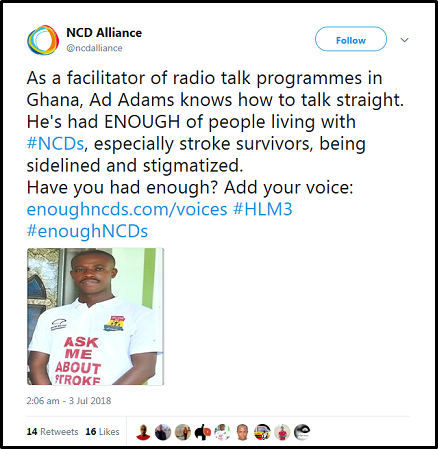
Members of the Ghana NCD Alliance, which includes the Stroke Association Support Network Ghana are aiming to raise awareness of Ghanaian political and major stakeholders on the need to prioritize NCDs as a national issue ahead of the UN HLM. Mr. Ebenezer Adams, the Vice Chairperson of the Ghana NCD Alliance, and member of the Stroke Association Support Network Ghana, gave the welcome address. He reminded participants that  NCDs, including stroke, affect people in every country, rich and poor, old and young, in cities and in villages, the privileged and the vulnerable. At some point in our lives, they are likely to affect each and every one of us.

On 7th August, a National High Level meeting was organised by the Ghana NCD Alliance. The Government was represented by the Hon Minster of Planning and the Chairman of the Inter Ministerial Committee. The Stroke Association called for improvement in the lives of people affected by stroke in Ghana, in particular through the national Livelihood Empowerment Program and through the realisation of the Global Stroke Bill of Rights.

Ebenezer Adams has added his voice to the #enoughNCDS Campaign 


Read more about the Stroke Association Support Nework Ghana SSO Spotlight


Stroke on the agenda at the NCD Alliance Our Views, Our Voices Training Workshop


Jelka Jansa of the Stroke Support Organisation Slovenia tells us about the recent NCD Alliance Our Views, Our Voices Training Workshop


How did you get involved in attending the NCD Alliance workshop in Geneva?
NCD Alliance sent an open call for applications. I am an occupational therapist working in an acute neurological hospital and I have become familiar with patient support organisations both locally and internationally, especially in the field of stroke. Therefore I responded to the questions and have used my own perspectives of being a main carer for my mum. She has been a stroke survivor for more than 20 years and has now additional health problems, including dementia and problems with breathing.

What was the focus of the workshop and what were the topics that you discussed?
The focus of this workshop was to train people living with NCDs to become an advocate and spokesperson.

The objectives of the workshop were:
  • To become familiar with NCDs, the 2018 UN High Level Meeting, policy landscape and advocacy opportunities.
  • To increase knowledge on mechanisms of participation/forms of involvement
  • To develop communication skills leveraging personal stories to call for change
  • To develop advocacy skills to mobilise communities and call for change
  • To increase confidence in being a spokesperson and advocate for NCD prevention and control
  • To develop a menu of actions to take forward the Advocacy Agenda of People
  • Living with NCDs and take advantage of the UN High Level Meeting on NCDs
How does this work connect with the issue of stroke awareness, prevention and support?
It links together very well. First of all, 90% of strokes are linked to 10 avoidable risks, by joint actions, including people living with NCDs, professionals, and policy makers, it is more likely that national governments will take necessary actions to control stroke incidence. In 2016,there were almost 14 million incidences of first-time strokes worldwide (Global Burden of Disease 2016). Their access to acute treatment and long term support is not even around the globe. It is important to call on the UN to guide national governments to invest into stroke care. For example, in Slovenia, rehabilitation access is limited and there is no community follow up as there is no rehabilitation taking place in patients’ homes.

What are the actions for you or others to do after attending this workshop? 
Spread the word about  NCDs and the UN High-Level Meeting campaign called ENOUGH. And invite other NCD groups to become involved with the “Our Views, Our Voices”. Stay connected and participate at events taking place just before the July  and September meetings in New York. The virtual space, facilitated by the NCD Alliance, provides a Community of Practice on the Meaningful Involvement of People living with NCDs. It is open to anyone who is affected by NCD and is willing to collaborate:  https://communities.gcmportal.org/plwncd  

Who else attended and did you identify any common issues in relation to the health conditions you work on?
There were representatives from other NCDs from all over the globe. There are differences, depending on the region. For example, in Africa one of the major issues is raising awareness and access to primary care. In many other regions people are facing problems with pollution that has multiple impacts on human health. Finally, many diseases still carry stigma with them. However, the common bottom line is that people living with NCDs have the power to make change regardless of location. The governments need to take action for having healthier citizens.

How can other SSOs get involved in the work of the NCD Alliance and the run up to the High Level Meeting on NCDs in New York later this year?
To visit Our Views, Our Voices website at: https://ncdalliance.org/what-we-do/capacity-development/our-views-our-voices   and get involved.
To join https://communities.gcmportal.org/plwncd   to share their own opinions to be able to further the Advocacy Agenda of People Living with NCDs.


Thursday, July 5, 2018

WSO calls for Increased Efforts and Investment to Reduce Global Burden of Stroke

Statement of the World Stroke Organization (WSO)
for UN Civil Society Interactive Hearing July 5th 2018, NYC


In preparation for the UN High Level Meeting on NCDs in September 2018, WSO is participating in the Civil Society Hearing at the UN. The organization is calling for urgent and specific action to reduce the global burden of stroke as part of the global effort to address NCDs. Below is the formal statement that has been prepared for submission to the Hearing.

NCDs in general - and cardiovascular disease with its two main components heart disease and stroke - continue to increase worldwide. Over the last 25 years, stroke has become the 2nd cause of disability and the 2nd cause of death worldwide. The burden of stroke disproportionately affects individuals living in resource-poor countries, where essential services including prevention, acute treatment and rehabilitation are unavailable; or only available to those with financial resources required for access. Most survivors of stroke carry a lifelong burden of physical, cognitive, mental, and socio-economic consequences, which causes an immense individual burden and DALY loss. In 2016 stroke accounted for 116 million years of life lived with disability (DALYS).

The major burden of stroke is in low and middle-income countries and it will grow dramatically unless there is a massive scaling-up of relevant interventions. Given the impact of stroke across all countries and continents, everyone is threatened by stroke. Stroke causes paralysis of an arm, a leg or half of the body, may impair the ability to speak or to comprehend language and vision, and may eventually lead to dementia. Stroke is an avoidable tragedy for patients, families and societies, because stroke is largely preventable and treatable. A significant proportion of global NCD burden can be attributed to stroke. Global improvement will depend on increased awareness, widespread availability and access to quality stroke treatment, primary and secondary prevention, and long-term care.

Research evidence underscores the impact that addressing stroke could have on the achievement of SDG3.  90% of strokes are linked to a few key detectable and modifiable risk factors that include hypertension, smoking, obesity, physical inactivity, and unhealthy diet. These factors are essentially the same for ischemic heart disease, the other main cause of disability and death around the globe.

An under-recognized long-term consequence of stroke and other NCDs, such as heart failure, chronic kidney disease, diabetes and hypertension is the development of dementia, which is also preventable and in some instances even reversible. This neglected long-term consequence represents a further major global health burden. Stroke and dementia often occur together, pose risks for each other and share common risk factors. It can be assumed that a major part of dementias is, in principle, preventable through coordinated action to prevent these diseases.

The WSO calls upon member states to increase their efforts in three domains

1)     Awareness: Member States must strengthen programs that increase awareness of stroke symptoms, stroke risk factors and prevention, and the consequences of stroke.

2)      Access and implementation: We support WHO, NCD Alliance Partners and Member States in their efforts to remove financial barriers to prevention and detection of NCDs through universal health coverage and essential medicines and devices including stroke units and re-canalization treatment as an evidence based policy; this will allow for implementation of population-wide prevention strategies and access to acute stroke services.

3)      Action: We support the WHO and UN Member States in the development of regional and national strategies (such as the HEARTS package and the implementation of WSO Global Guidelines for Quality Stroke Care) to deliver the health-related Sustainable Development Goals, in particular for the reduction of premature NCD deaths by one-third by 2030.

Following the publication of WHO ICD 11 and the classification of stroke as a disease of the Nervous System, we strongly suggest that “stroke” as a distinct disease entity is made more visible in NCD discourse. While stroke has many of the same risk factors as heart diseases, we argue that it requires targeted action and policy responses that reflect the scale of the disease. More importantly, the symptoms of stroke, its treatments and its consequences are unique and sorely underrecognized by the public, adversely impacting access to appropriate treatment and patient outcomes. 

The close relationship between heart disease, stroke, hypertension, diabetes and chronic kidney disease supports the concept of the coalition for vascular health that the WHF, WSO, WHL and the diabetes and kidney societies, together with other stakeholders have created.

The magnitude of the associated health problems and the projected worldwide increase of all these conditions makes an even stronger argument for best practice in prevention and management of stroke and all other conditions which would lower premature mortality, DALYs and preventable dementia.

In summary, the WSO strongly supports all efforts to upscale actions in reducing the burden of NCDs and wants to point out that all actions should be seen as investments, not as cost.

There is much we can do immediately. The first biggest step is to give to stroke the visibility it requires. For many stroke is still summarized under ‘cardiovascular diseases’ but should from now on be correctly be considered and referred to as 'Heart Disease and Stroke’.

#stroke
#enoughNCDs

#HLM3

Wednesday, May 23, 2018

One World Voice for Stroke

Left to Right: Patrik Michel Swiss Stroke Association, Mia Grupper WSO Exec Director,
Prof Werner Hacke President WSO, Prof Bo Norrving Chair Global Policy Committee, WSO

WSO advocacy around the 71st World Health Assembly and UN High Level Meeting on NCDs


The World Stroke Organization leadership team are in Geneva this week. Alongside WSO membership and patient representatives, they are contributing to critical health policy discussions taking place in and around the 71stWorld Health Assembly.

Featured Post

Epidemiologic profiling for stroke in Nepal: Endeavour towards establishing database

Resha Shrestha  @avi_neuro. , MS 1 , Avinash Chandra, MD 1 , Samir Acharya, MS 1 , Pranaya Shrestha, MS 1 , Pravesh Rajbhandari, MS 1 , Re...