🎧Peter Knapp on the 📻Frequency of #anxiety after #stroke: an updated systematic review and meta-analysis of #observationalstudies👉CLICK HERE TO LISTEN
The International Journal of Stroke is the flagship publication of the World Stroke Organization.
Monday, March 2, 2020
🎧Peter Knapp on the 📻Frequency of #anxiety after #stroke
Wednesday, February 19, 2020
Eivind Berge 1964-2020
It is with great sadness we announce the death of Professor Eivind Berge.
He died in early February from aggressive prostate cancer. He was a major contributor to stroke science and to evidence-based medicine.
He ran large clinical trials of his own, but also had major roles in key international stroke trials.
He was a research leader, a mentor to junior researchers, and a good friend to many in the stroke community.
His wise judgement and broad experience were highly valued by colleagues around the world.
His work with trials, systematic reviews and guidelines have improved the treatment and prognosis of stroke patients. Eivind had a unique combination of wisdom, kindness and determination and our community has lost a wonderful friend and colleague.
Our thoughts are with Eivinds’s family.
Monday, December 16, 2019
POCAST RELEASE IJS 🎧 LISTEN Informal caregivers in stroke: life impact, support and psychological well-being - a Swedish🇸🇪 Stroke Register (Riksstroke) study with Stefan Sennfalt
🎧LISTEN Informal caregivers in stroke: life impact, support and psychological well-being - a Swedish🇸🇪 Stroke Register (Riksstroke) study with Stefan Sennfalt https://www.podbean.com/media/share/pb-p349q-cb7e4c#.Xfb8LUMrH_I.twitter
Find the article here!
Thursday, October 31, 2019
Hundreds gathered to raise awareness and support life after stroke in Singapore and Malaysia
WSO Stroke Support Organisations in Singapore
and Malaysia led inspiring events to raise awareness and celebrate life after
stroke. The events also raised the flag for the World Stroke Campaign virtual relay Asia route #DontBeTheOne
For more information about SNSA visit:
Singapore
National Stroke Association (SNSA) held its fourth Stepping out for Stroke
event on Saturday 12th October. The event had over 800 registered
participants including nearly 100 stroke survivors and carers.
Stepping out for
Stroke is SNSA’s annual fundraising event, where it encourages participation
from people affected by stroke, medical professionals, students and the wider
community in whatever way they choose; walking, running, cycling, and in
wheelchairs and pushchairs. The Mayor of Central Singapore CDC, Denise Phua was
the guest of honour and talked passionately about the need to prevent avoidable
strokes and to support life after stroke.
Aanandha Sharurajah, who had a stroke in 2012 and is a member of the SNSA Executive Committee said, 'Stepping out for Stroke was a really important day for me, as it was a day my whole family was involved in. We all wore our purple t-shirts, showing that we were standing for stroke survivors and greater awareness of this illness, and it was the largest number of people I've witnessed so far standing for stroke'.
The event was
an opportunity to mobilise the community to raise funds, increase awareness of
stroke and engage in physical activity. The day also included the launch of
the FAST Heroes 995 Programme in Singapore, which is a collaboration between
SNSA, Boehinger Ingelheim’s Angels Initiative and the World Stroke Organization
https://worldstrokeorganization.blogspot.com/2019/07/be-stroke-superhero-be-fast.html.
The programme is a kindergarten-level education initiative aimed at equipping children with knowledge
about what stroke looks like and what to do in an emergency.
The event also
joined the World Stroke Campaign virtual relay Asia Route, getting behind the
#DontBeTheOne 2019 Campaign theme.
Ng Wai May,
President of SNSA said 'Our signature Stepping out for Stroke community
event was held on 12th October 2019. The event was very
successful with over 800 participants and we have raised over $60,000 so that
we can offer free programmes for stroke survivors and caregivers'.
Stroke Games 2019 kicked off on Saturday 19th
October with a vibrant opening ceremony, with flags from
Malaysia, the National Stroke Association of Malaysia (NASAM), World Stroke
Organization #DontBeTheOne and the nine NASAM contingents from across Malaysia. The event was
declared open by YABhg Tun Jeanne Abdullah, Patron of the Malaysian Paralympic
Council. Before its arrival into the stadium, the Stroke Games torch was
passed on by a relay of stroke champions who ran, walked or wheelchaired it
along the way.
'How do you inspire someone who is down and out after
a debilitating stroke?' asked Janet Yeo, Founder Chairperson of NASAM, in
her opening speech. 'How do you inspire
that person to climb mountains, to aim high and excel? To aspire to be a
champion and to believe there is life after stroke?'
'When you are inside a stroke damaged body, believe me
the last thing on your mind is sports or competitiveness,' said Yeo, a stroke
survivor herself. 'We at NASAM want to
reach out and mend such broken spirits and one of the ways is through sports. For
a whole year we carefully crafted and designed sporting events and then
transferred them into our daily rehab regime before our first
Games in 2017. Suddenly rehab was no
longer a boring word. It was not a passive, repetitive routine'.
Yeo added that the Stroke Games 2019 is bigger and will
generate more champions who will inspire others to achieve greater
recovery. 'The Games is NASAM’s
contribution to the stroke community around the world. We wish that this
fighting spirit of a stroke champion is ignited into every person affected by a
stroke no matter where they are’.
The Games involved more than 800 participants from
NASAM’s nine clubs across Malaysia as well as volunteers from corporations,
universities and hospitals. There were 25 events including: 50m and 300m walk/run;
hand cycle; modified weight lifting and seated volleyball. The youngest athlete was Lee Yong Xian aged
16, who represented Kuantan in the 300m for men. The oldest was Mariya Pillay aged 81,
representing Malacca in hand cycle for women.
For more information about NASAM visit:
www.nasam.org |
facebook.com/NationalStrokeAssociationMalaysia
Tuesday, October 29, 2019
World Stroke Organization Launches Strategy to Cut Stroke in Half
NEWS RELEASE
On World Stroke Day Oct 29th, the World Stroke Organization has announced the launch of an ambitious global strategic framework that has the potential to cut global stroke incidence by half.
The framework, developed by an international network of leading stroke clinicians and researchers, builds on strong evidence of impact in the prevention of stroke and circulatory disease. It provides a roadmap for governments and health systems that points prevention focus towards low and medium risk populations with an approach that combines improved access to stroke preventive treatment, development of a stroke trained community health workforce, improved public awareness and mobile technologies that support the identification of risk factors and individual behavior change. A study trial that aims to prove the efficacy of the WSO strategy and the feasibility of implementation in other locations is scheduled to start in Brazil, through a partnership of the Ministry of Health and the Hospital Moinhos de Vento.
‘The latest data analysis shows that 1 in 4 of us will have a stroke in our lifetime, just 10 years ago that risk was 1 in 6. Stroke is a devastating disease and is a leading cause of disability and death worldwide. It is essential that we act urgently and focus our efforts on where we can have greatest impact on prevention’ said WSO President Prof Michael Brainin. ‘We need action at every level, from governments we need policies to address the drivers of stroke such as taxation of diet, alcohol and tobacco. We also need them to invest to ensure access to screening and preventive treatments. For individuals we need everyone to understand their risk and to commit to taking the steps they can to prevent a stroke.’
This year’s World Stroke Day #DontBeTheOne campaign aims to raise public awareness of stroke with a high profile social media campaign a patient information website complemented by on the ground activities by WSO members urging people to get informed about stroke risk.
For more information contact campaign@world-stroke.org
Friday, October 25, 2019
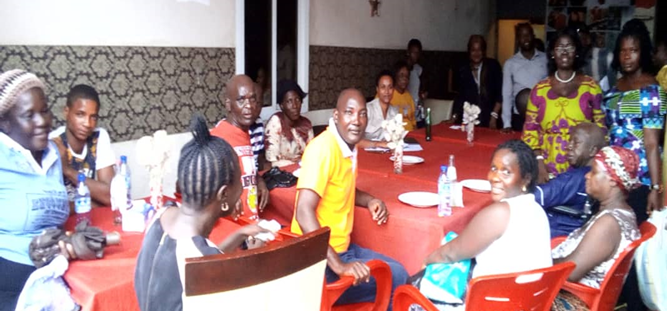
Stroke in Sierra Leone (SISLE) research group aims to understand and improve stroke care
Stroke in Sierra
Leone (SISLE) is a research collaboration funded by the National Institute of
Health Research (NIHR), the UK’s largest funder of health and care research, between
King's College London and the College of Medicine and Allied Health Sciences (Freetown).
This group is carrying out mixed methods research to try and understand stroke
in Sierra Leone.
Here in this
introductory blog, the team gives us an overview of the project, and the impact
of stroke in this country.
The Kamara family were enjoying a
boisterous Sunday lunch in the family home after church. As usual Pa
Alusine, the head of the family presided over the lunch, his sense of humour and
playful nature had the grandchildren squealing with laughter.
He excused himself briefly to go
to the bathroom, when his daughter looked back and saw him gripping the door
frame and making a funny face, she thought it was another joke for the grandchildren.
It took a few moments to realise
something wasn't quite right.
Pa Alusine was gripping the doorframe because
he had lost the strength in his right leg. He was unable to speak, he couldn’t ask
for help.
The family reacted quickly and
laid him on the bed. They called a nurse who lived in the community nearby, she
arrived at the bedside soon after. On her advice the family placed him in a car
and drove directly to Connaught Hospital.
Pa Alusine had had a stroke,
something that is not well understood in Sierra Leone.
Stroke in Sub
Saharan Africa
The disease burden of stroke is increasing in this region
because of increases in poor diets, smoking, alcohol consumption and lack of
exercise.
As a result of these changes more people in cities like
Freetown are at risk of non-communicable diseases such as stroke.
However, many things about stroke in this region are not
understood, such as; which ethnic groups are most at risk? How long does it
take patients to come to the hospital after a stroke? What is the cost of care?
How do survivors’ lives change as a result of stroke?
The Connaught
Hospital Stroke Register
The SISLE project is using a stroke register model to
collect data about strokes.
A stroke register is an observational database that is
focussed on gathering clinical information and data on the outcomes of
patients. These observations can then be used to both understand and improve
stroke care.
The stroke register that we have launched at Connaught
Hospital, the main government referral Hospital in Freetown, is Sierra Leone’s
first. It is collecting data, at admission, 90 days, 12 months, and 2 years
post stroke.
The information being collected is on sociodemographic
factors, stroke risk factors, stroke severity, treatment, and outcomes. We have
now been collecting for 199 consecutive days and have 221 participants on the
register
We are beginning to understand stroke in Sierra Leone much
better, however there are some aspects of stroke in this country, that a stroke
register will not help us to research.
These are the aspects of stroke that are linked to societal
and cultural perspectives, and inherent beliefs. To be able to understand this
we have reached out into the community. The Stroke survivors’ group is
educating physicians and researchers on the experiences in Sierra Leone.
Life after Stroke
in Sierra Leone
We are beginning to understand through our work with the stroke
survivors’ group, the challenges of living with stroke disability in Sierra
Leone
Lack of public awareness about stroke has led to there being
societal stigma and discrimination directed towards stroke survivors, this
makes their post stroke life more difficult.
One of the survivors highlighted how taxi drivers wouldn’t
allow people with disability into their vehicle
Some survivors even highlighted how because they now had
some form of disability, they felt like their communities were shutting them
out, they felt ostracised.
World Stroke Day
With this in mind, the stroke survivors suggested that we
carry out a walk for World Stroke Day to raise awareness of disability and
hopefully reduce social stigma.
On the 29th October, the stroke survivors,
members of the SISLE team, and the general public will be carrying out an
awareness walk on city beach, Freetown. This will form the Sierra Leone leg of
the World Stroke Organization World Stroke Day Relay.
Wednesday, October 23, 2019
Preventing heart disease and stroke, saving lives and promoting recovery and wellbeing in the west of Ireland
Patricia Hall, Cardiovascular Nurse Specialist at Croí, the Heart and Stroke Charity based in the west of Ireland, tells us about the history of the organisation that has recently become a member of the World Stroke Organization.
Croí, established in Galway, Ireland in 1985 initially focused on the development of
local and regional cardiac services and facilities, our mission has now shifted to cardiovascular disease prevention and
rehabilitation, which encompasses stroke. Our goal is to prevent heart disease
and stroke, save lives and promote recovery and wellbeing.
![]() |
| Patricia Hall (centre) with members of Croí's Stroke Support Group |
Each year approximately 10,000 people have a stroke-related event in Ireland,
with an estimated 30,000 people living with disabilities as a result of a
stroke. Our goals include raising awareness of
the risk factors, signs of stroke and promote healthy lifestyles.
Stroke support services
Our experience in cardiovascular disease prevention has informed
our development of stroke specific educational programmes and we support stroke
survivors and family carers on their journey to live the best possible life
after stroke. The Croí Heart and Stroke Centre provides a meeting place for
people who have been affected by stroke – patients, family members, carers and
friends, which enables them to come together and participate in various
activities. While everyone’s experience of having a stroke is different,
meeting other stroke survivors or caregivers who understand what they are going
through can help with recovery. Making this connection
can be vital – to learn more about stroke recovery options and to share the
experiences of recovery from stroke.
Croí offers a
range of stroke support services, which include:
·
Stroke
support groups which meet in Galway and in Mayo.
o
Our
stroke support groups meet once a month, coming together to
participate in various activities including a chance to have fun, learn skills
and meet new people. Whether it’s a listening ear or practical guidance and
information, we support members in rebuilding their lives after stroke –
regardless of where they are in the stroke journey.
o
Our
stroke family carers’ group also meets separately throughout the year. Coming
together to share experiences, reduce isolation and provide support to others
in similar situations.
·
Specialised
physical activity programmes and Yoga, designed specifically for those who have
had a stroke.
·
Communication
group run by a speech and language therapist for those with speech and
communication difficulties following stroke.
·
Health
and lifestyle educational programmes that focus on risk reduction.
·
Fun
activities, like our summer day out, World Stroke Day event and Christmas party
every year.
The aims of
Croí’s stroke support group are:
·
To
create a positive environment to meet others and share experiences.
·
To
provide advice, education and support on stroke and good health.
·
To
encourage participation in enjoyable activities beneficial to your wellbeing.
·
To
provide information on how to access services local to you.
·
Peer
support and friendship.
Additional
activities this year included:
·
Roll
out of the MyStroke Programme. This is a 4 week educational programme focused
on risk reduction for stroke survivors and family/carers.
o
Topics
included:- what is a stroke and how to prevent recurrence; dealing with
emotions, self-esteem and intimacy after stroke; stroke specific exercise;
healthy eating after stroke.
World Stroke Day
In recognition
of World Stroke Day, Croí
is hosting a Public Talk and Short Film screening to help raise awareness of
stroke and offer information to stroke survivors.
This FREE event
will start at 7pm on October 29th in the Croí Centre in
Newcastle, Galway, and will include a talk by Dr. Tom Walsh, Stroke Specialist,
Galway University Hospital and a local Galway stroke survivor, followed by a
special screening of the award-winning documentary, A Tiny Spark.
As an
independent not-for-profit organisation, our work is entirely funded from our
own fundraising and revenue generating activities. For more information, please
visit www.croi.ie and follow Croí on Facebook,
Twitter and Instagram at @croiheartstroke.
![]() |
| Croí Centre Galway Ireland |
Seven minutes in stroke - Dr A Antonio Arauz
Dr A Antonio Aruz
Stroke Clinic
Instituto Nacional de Neurologia y Neurocirugía Manuel Velasco Suárez
Mexico City
1. What inspired you towards neuroscience?
Honestly, my first option was cardiology, but I was accepted into a great Mexican Neuroscience Institution (Instituto Nacional de Neurología y Neurocirugía Manuel Velasco Suárez) and there I began to deepen in Neurosciences. It has been a great adventure. The challenge of neurological diagnosis, the exact location of brain lesions, based on clinical findings. The breakthrough in diagnostic and treatment methods are fascinating.
2. Why stroke?
Stroke is one of the leading causes of death in Mexico, but mainly it is the leading cause of disability. In the 80s the study of patients with stroke was completely different, but it was a major clinical diagnostic challenge. That’s why I decided cerebrovascular field. I’am lucky to have witnessed the great changes in the diagnosis and treatment of stroke. At the beginning (20 years ago) that I began the study of cerebral vascular diseases, there was little that could be done in the acute treatment of ischemic stroke. Things are now, totally different.
3. What have been the highs so far?
To be able to work in a multidisciplinary team, including neurosurgeons, interventionists and rehabilitation specialists, and with colleagues from other countries, in multinational groups, but mainly participate in the training of medical doctors, neurologists, and stroke neurologists.
I still feel excited that our manuscripts are accepted and see them published. And of course, seeing the recovery of a patient after stroke is always a great achievement.
4. What have been the lows?
It has always been frustrating to have nothing to offer to our patients and this is frequent in many cases. Although there are great advances in acute ischemic stroke, there is little we can do in intracerebral hemorrhages, in some vascular malformations, etc.
Driving change in the national/local stroke care system it is often frustrating. The public policies in my country are almost impossible to modify and try to have an acute stroke treatment system, is still a pending issue in Mexico.
5. How do you balance work life with the needs of home life?
It is always a challenge. In my case, it has been changing over time, with the different stages of growth of my sons. However, family is always the priority. Thankfully my wife Alma, and my son’s Eduardo and Fernando have been very supportive.
6. Who are your most important mentors and how did you find them?
I am very grateful to Fernando Barinagarrementeria for introducing me to the field of vascular Neurology. Over the time Fernando has been not only an academic mentor. He has been a friend and I have had the privilege of sharing with him many projects, meetings, trips, as well as discussions about stroke, politics and life itself.
During my time as a Neurology resident, in addition to Fernando, there were some other professors who undoubtedly influenced my training.
7. What are your most important collaborations and how have you built them?
I am also fortunate to have been able to have very important collaborations. For example with Peter Sandercook and the IST3 group, or in the SPS3 project with Oscar Benavente and Bob Hart.
Other important collaborations have arisen from my interest in arterial dissections and cerebral venous thrombosis in our population, which has allowed us to participate in collaborative work groups.
More recently in the ESUS working group and NAVIGATE ESUS trial. Although this was a negative trial, it has generated many manuscripts published in high impact journals. A good example is the sub-analysis of the regional, sex and age differences in Diagnostic testing published in International Journal of Stroke.
These collaborations have been built by the publication on specific topics, by reference of other colleagues or by previous collaborations.
Tuesday, October 15, 2019
Wednesday, October 9, 2019
New Philippine stroke support organisation makes public stroke awareness its priority #DontBeTheOne
Jacob Eagan Bright, founder of Stroke and Aneurysm Support Philippines, shares his experience of stroke and his motivation to create public awareness and support life after stroke.
What has
inspired you to be involved in stroke support?
![]() |
| Jacob Eagan Bright |
In 2018 I lost a brilliant colleague to stroke, his
loss made me sad and also bewildered as to why this happened to him and his
young family, who were left to grieve. Then in 2019 my grandmother woke up in
middle of the night, trying to use the bathroom she dropped down, face and
mouth instantly twisted, her left hand became stiff and cold and unmovable. Months
later my comrade, a 48 year old retired army officer experienced a transient
ischaemic attack (TIA), and then a burst aneurysm and a haemorrhagic stroke.
Seeing my friends and family touched by stroke and its
devastating effects, I realized that anyone can be affected. Stroke is the
second leading cause of death in the Philippines. I became motivated to create
public awareness to prevent strokes and to work with stroke survivors as
advocates.
What does stroke
care look like in your country?
The Department of Health has now made alteplase, the clot-busting drug, available for free in 26 government hospitals nationwide. This
effort is highly commendable, but there is no support for local patient care
organizations carrying out awareness and education on prevention and recovery
programs for survivors.
The public are interested in attending stroke
education and awareness sessions but due to low income levels there is a lack
of public fundraising.
How did the
project come about?
After many conversations, it became clear that many
people affected by stroke were not previously aware of stroke risk factors, and
that caregivers and families were totally ignorant of the symptoms and effects.
So right there is was glaringly obvious that public education is desperately
needed, especially on healthy lifestyles and coming to terms with life after
stroke.
What have been
some of the outcomes of the project?
After two months we are still in the pilot phase of
our work, but it is amazing how receptive survivors and those wanting to
prevent stroke are to full information and education on how to prevent a stroke
and life after stroke. At the moment our sessions and outreach are well
attended. People call to ask when next we are due for a speaking engagement, and
many health professionals link up with us for outreach engagements. Our home
visits to survivors seem to be very encouraging to them in believing there is a
reason to live.
What has been
the feedback from stroke survivors to the project?
Engaging survivors in public meetings has given them a
sense of belonging and reason to live and to become active. Survivors are happy
there is an organization that brings them together, where they can share their experiences,
both challenges and successes, in their journey after stroke. The project also
checks in with them and supports them to sustain healthy behavior that
contributes to their recovery.
What has been
the response from others – community, doctors, politicians?
The community has responded collaboratively to our
project and engaged with our efforts
and programs. Our contact number keeps ringing, but unfortunately the community
expectation is that we can deal with all their requests – including supplying
an ambulance if a member of the public has a suspected stroke. Public doctors seem to be very happy with the
program and are willing to participate in public events as speakers; this is
something that we want to build on. Private doctors seem to be a little
uncomfortable because we may be perceived as a competitor. We want to pursue
building a relationship with them.
What would you
say to other people to make them take stroke prevention seriously?
You could be the next person hit by stroke. Don’t Be
The One.
Monday, October 7, 2019
Seven minutes in stroke - Dr Anderson Tsang
There are so many components when it comes to stroke research, and the Seven Minutes in Stroke series highlights the part played by researchers. Over the years we've covered so many researchers and their motivations, highs and lows, and the ever important quesiton of personal life balance. We love to hear your responses and invite researchers to email Seven minutes in stroke answers to carmenl@world-stroke.com. Now, let me introduce Dr Anderson Tsang submitting author fo the article 'Overview of endovascular thrombectomy accessibility gap for acute ischemic stroke in Asia: a multi-national survey' that has recently been published in the Interntional Journal of Stroke.
1. What inspired you towards neuroscience?
I have always been intrigued with the functional eloquence of the central nervous system and became interested in clinical neuroscience during my formative years in medical school. The localization of cognitive abilities to different areas and circuits of the brain and the plasticity of the developing brain was fascinating to me. As a medical student, I was fortunate to be exposed to laboratory work on neuro-regeneration as well as the rapidly developing field of neurosurgery, which further strengthened my conviction in a neuroscience career.
2. Why stroke?
Stroke is one of the most common, unpredictable and devastating disease faced by mankind. While previously considered an irreversible event with much of the care focused on rehabilitation, the development of acute revascularization therapies such as thrombolysis and thrombectomy in the past decade have completely shifted the attention to emergency stroke reperfusion. Successful acute reperfusion therapy can potentially reverse the debilitating deficits of a severe stroke, and witnessing the quick recovery of these patients is extremely gratifying for the medical team. I am excited to be part of this paradigm shift in stroke treatment.
3. What have been the highs so far?
To be able to work with a great team of dedicated neurosurgeons and nurses is a blessing. I am fortunate to have wonderful colleagues who love what we do. The position as an academic neurosurgeon enabled me to make international friends with common interest and inspired my continuous pursuit in this field.
4. What have been the lows?
Driving change in the local stroke care system has been painfully difficult, in part due to bureaucracy and politics. The lack of support and interest in clinical research locally in comparison to other developed healthcare systems is also disappointing.
5. How do you balance work life with the needs of home life?
It is an ongoing challenge and I can’t say I have this figured out, especially with a new baby in the house now. Family will always be the priority and thankfully my wife Jennie has been very supportive. I do believe that balanced and quality family / personal time is essential to a productive professional life.
6. Who are your most important mentors and how did you find them?
I am very grateful to Dr. Wai Man Lui for introducing me to the field of vascular and endovascular neurosurgery. His genuine care for the patient set a high standard for the team. Prof. Gilberto Ka Kit Leung is instrumental in my development as an academic neurosurgeon and has given me countless opportunities. My interventional neuroradiology fellowship mentors Prof. Timo Krings and Prof. Vitor Mendes Pereira are phenomenal teachers in neurovascular anatomy and endovascular techniques. To be able to work alongside these giants is an inspiring experience.
7. What are your most important collaborations and how have you built them?
Multi-disciplinary research is often the most exciting and our projects with engineers, statisticians and computer scientists in machine learning and artificial intelligence application in stroke is rapidly progressing. My time in Toronto during my fellowship training has also build a network of personal and professional friendships which supported my work and generated many new ideas.
Dr. Anderson Chun On TSANG
Clinical Assistant Professor, Division of Neurosurgery, Queen Mary Hospital, The University of Hong Kong, Hong Kong.
Subscribe to:
Posts (Atom)
Featured Post
Epidemiologic profiling for stroke in Nepal: Endeavour towards establishing database
Resha Shrestha @avi_neuro. , MS 1 , Avinash Chandra, MD 1 , Samir Acharya, MS 1 , Pranaya Shrestha, MS 1 , Pravesh Rajbhandari, MS 1 , Re...
-
Takafumi Kubota 1,2 , Arsalan Anwar 3, and Sidra Saleem 3 1. Department of Neurology, Teine Keijinkai Hospital, Sa...
-
The renowned artist and popular Bengali writer, Debabrata Chakraborty, talked with Professor Dipes Kumar Mandal of the Stroke Foundation o...