Monday, August 13, 2018

Health information for stroke survivors, families and carers available in different languages


New: health information available in different languages


The Stroke Association in the UK are proud to announce that it has published translations of its main health guides.

You can now access the Stroke Association's main general guides in South Asian languages, Welsh, and a wide range of European languages. The Stroke Association has translated its most popular general guides to stroke and stroke prevention. These include When you have a stroke, Next steps after a stroke, Supporting a stroke survivor and How to reduce your risk of a stroke.

The European language translations were coordinated by Stroke Alliance for Europe (SAFE). Printed copies of these guides are being distributed in selected hospitals in each country, and you can download PDFs from the Stroke Association website.


How can I access the translations?

You can order print copies, stream audio online, and download PDFs from the Stroke Association website. For a full list of languages and publications, visit its translations web page.


Sunday, July 29, 2018

Report from the ‘Brain diseases - from bench to bedside’ conference, Moscow April 12-13, 2018.


The meeting, organized by Professors Eugene Gusev and Alla Guekht, focused on the recent developments in translational research and treatment innovations in cerebrovascular diseases, epilepsy, cognitive impairment and dementia, depression, demyelinating diseases and others. It was held at the Buyanov City Clinical hospital, and was organised in partnership with the following institutions: Ministry of Health of The Russian Federation, Russian Academy of Sciences, Moscow Healthcare Department, Pirogov Russian National Research Medical University, World Stroke Organization, European Stroke  Organization, World Federation of Neurology, International League Against Epilepsy, European Federation of Neurorehabilitation, All-Russian Society of Neurologists, Moscow Research and Clinical Center for Neuropsychiatry. 

The Conference Faculty had a high-level meeting with Professor V. Skvortsova, Minister of Health for the Russian Federation, to discuss the management of stroke and brain disorders and highlight the priority this should be given both internationally and within the Russian Federation.  An action plan on collaborative strategy in brain diseases has been discussed.

The conference proved very popular and over 700 delegates from 42 cities of the Russian Federation attended with additional registrants from Belarus, Georgia, Kazakhstan, Tajikistan, Ukraine and Uzbekistan. The conference attracted a high level of media coverage and both Professors P. Sandercock & V. Caso gave video interviews for local media organisations. 


The stroke session began with an update on ‘Controversies in thrombolysis’ by P.Sandercock, who highlighted the importance of not withholding thrombolysis to patients with ischaemic stroke purely on the basis of age over 80.  V. Caso gave a powerful talk on ‘Life after stroke in women’. She highlighted the particularities of stroke management during pregnancy and demonstrated how gender inequality results in adverse effects in women’s healthcare in general and in stroke outcome in particular. M. Hilz gave a detailed overview of autonomic dysfunction in diseases requiring neurological intensive medicine. V. Parfenov covered management of patients after stroke, highlighting the value of lifestyle changes (quitting smoking, increasing physical activity and fresh fruit and vegetable consumption) and antithrombotic therapy with aspirin after ischaemic events. I. Koltunov, N.Pechatnikova and V. Kakaulina presented their work on Cerebrovascular diseases associated with genetic metabolic disorders and demonstrated the program of genetic screening for rare diseases, supported by the Moscow government. A. Pryamikov, A.Mironkov and O. Sazhina, doctors from the Regional Stroke Center in the host hospital, closed the session with an interesting talk on their experience on carotid endarterectomy and internal carotid artery stenting in acute stroke. 

The clinical stroke-focused session was followed by a translational science session, which covered a broader range of topics.  I. Blumke reported work from The European Epilepsy Brain Bank Consortium: 25 years of interdisciplinary experience with epilepsy surgery in 9579 children and adults, L. Østergaard presented novel data on the role of capillary pathways in stroke and cognitive decline, N. Gulyaeva highlighted how distant hippocampal damage in brain disorders may be related to corticoid-mediated mechanisms. A. Shpak spoke on neurotrophic factors in neuro-ophthalmology, showing their important role in glaucoma as the model of neurodegenerative diseases.  D. Muresanu gave a talk titled ‘From neurobiology to evidence based medicine: concepts in neurorehabilitation after stroke’.  
The session on cognitive and affective disorders was opened by the lecture by M.Feedman focusing on the diagnostic and treatment challenges of frontotemporal dementia. R. Akzhigitov and co-authors gave an overview on depression in neurological diseases, presenting the huge experience of the Moscow Research and Clinical Center for Neuropsychiatry with the very effective programs of multidisciplinary management of depressions and cognitive impairment, including post-stroke.
The session on the following day was dedicated to epilepsy. V.Krylov and I.Trifonov presented the results of the epilepsy surgery program, which is successfully developing in Moscow and other cities of the Russian Federation. S. Wiebe gave a thorough overview of the outcomes of epilepsy surgery. He emphasized that the novel way of conceptualizing surgical outcomes highlights the importance of longitudinal data. N.Specchio described special issues of epilepsy surgery in children. A.Hauser demonstrate how TBI and post-traumatic epilepsy represent a substantial societal burden. He reviewed the major risk factors and stated that studying the predictors of epilepsy after TBI should become one of the priorities. The successes and challenges in the implementation of the 68th WHA resolution on epilepsy have been presented by E.Gusev and A.Guekht. They demonstrated that epilepsy is comorbid to stroke and other major noncommunicable diseases, dramatically increasing their severity and mortality. The last session was opened by E.Beghi with the talk describing the mechanisms and predictors of falls in neurological diseases, including stroke, Parkinson’s disease, multiple sclerosis and others. He stressed that stroke can be the cause of balance disorders due to impaired ability to produce fast, accurate and coordinated muscular patterns. Several interesting talks were presented by Russian colleagues on multiple sclerosis, including the burden of multiple sclerosis (V. Mkrtchyan, N. Pavlov) and therapeutic approaches (N. Khachanova and N. Arzymanian). The novel techniques and experience of neurostimulation in gait disorders in multiple sclerosis patients were presented by the neurosurgery team of the Buyanov City Clinical hospital (S.Asratyan). The significant part of the session was dedicated to management of ALS, presented by members of the Russian and foreign faculty. 
The interactive video session concluded the conference with presentation of interesting cases in different aspects of neurology and with a lot of discussion.

On the next day, the international faculty and the leading Russian specialists on brain diseases visited the Moscow Research and Clinical Centre for Neuropsychiatry of the Healthcare Department of Moscow, one of the leading institutions for management of patients with post-stroke cognitive impairment, depression and anxiety, suicidal ideations, epilepsy and other brain diseases. It was the second meeting of the international scientific advisory board of the Research and Clinical Centre, formed in October 2017 during the World Stroke Day Congress in Moscow. 
The meeting started with an overview of the >100 year history of the center, presented by its director A. Guekht. The scientific achievements, patient management and educational activity of the center, as well as the state of the art facilities for diagnostics and research were quite impressive. 

Professor N. Gulyaeva (Institute of Higher Nervous Activity, RAS) presented the results of studies in translational neuroscience. Then, completed and ongoing research projects in post-stroke cognitive impairment, epilepsy, depression and suicide, and autonomic disorders were presented by the specialists of the Center and of collaborative institutions (Pirogov Russian National Research Medical University, A.I. Yevdokimov Moscow State University of Medicine and Dentistry, Serbsky State Scientific Center for Social and Forensic Psychiatry, Institute of Higher Nervous Activity and Neurophysiology of RAS, N.V.Sklifosovsky Research Institute of Emergency Medicine and Buyanov City Clinical Hospital). The projects were extensively discussed by the faculty, and plans for international publications and new projects had been developed. The true highlights of the meeting was a series of seminars in stroke and other brain diseases led by the eminent members of the international faculty. These seminars were of high educational value for the doctors and researchers from Moscow clinics.

The conference closed with warm thanks from the organising committee to the supporting organisations, the conference faculty and conference participants for their efforts in improving the outcomes for people with stroke and brain disorders. The conference strengthens the international collaborative efforts to tackle these disorders, which place such a burden on patients, society and health systems.
Peter Sandercock

29th Dubrovnik Summer Stroke School: Healthy Lifestyle and Prevention of Stroke and Other Brain Impairments

International Course, endorsed by World Stroke Organization, European Stroke Organisation, World Federation of Neurology and European Academy of Neurology  

The 29th Summer Stroke School: Healthy Lifestyle and Prevention of Stroke and Other Brain Impairments, International Course, took place in the beautiful city of Dubrovnik, Croatia, from  04th-08th of June 2018. The school was organized by International Institute for Brain Health and Croatian Stroke Society and was attended by numerous participants from Macedonia, Croatia, Bosnia and Herzegovina, Slovenia, Austria, Albania, Latvia, Lithuania, Germany and Japan. The scientific program consisted of lectures delivered by well-known international speakers who shared their rich experience and knowledge. All aspects of stroke and related brain disorders were covered during the 5 day’s course. World Stroke Organization was represented by prof. Vida Demarin, as a founder and director of the School who made introduction and showed us recent advances in neurosonology. Prof. Peter Sandercock talked about 30 years of evidence-based medicine and the Global burden of stroke and also gave us hints and tips on how to start our own stroke research projects. We heard all about TIA as an emergency condition from Prof. Natan Bornstein, University of Tel Aviv, Vice-President of the World Stroke Organization. He also delivered a great overview of the secondary stroke prevention, emphasizing all important aspects of this issue, and at the same time, actively interacting with the audience, giving practical advice and solutions to different clinical scenarios that arise from the everyday clinical practice. Prof. Roman Haberl from Munich and his collaborators as well as Prof. Kurt Niederkorn from Graz and many other lecturers shared their knowledge and expertise and during five day course participants  acquired lots of recent information and discussed the most relevant and recent scientific achievements in the field of stroke and neurodegenerative diseases.
The social program was very exciting and enjoyable as well, marvelously organized after the scientific program by our local host, Dr. Andrijana Bogoje from Dubrovnik.

We are looking forward to the 30th anniversary of the Dubrovnik Summer Stroke School that is already planned for the next year and you are all cordially invited to attend it!

By Vida Demarin, Hrvoje Budincevic and Anita Arsovska


Friday, July 27, 2018

Stepping out and stepping up for stroke in Argentina


World Stroke Day provided an opportunity for stroke survivors and supporters in Argentina to take their first steps in raising awareness of stroke prevention. The day also helped to lay the foundations for the country's first stroke survivor organization which organizers hope to launch on World Stroke Day 2018.

Here, World Stroke Campaign Award Winner Maria Martha Esnaola y Rojas shares an overview of how Argentina is stepping out for stroke awareness.

Argentina is a very huge country with a very complicated and fragmented health system organization. There have previously been some individual initiatives to celebrate the World Stroke Day, from many private institutions and organizations. On July 2017 we created the “World Stroke Day Commission” with members from different medical societies and support from the government and we started to plan the “First Argentinian Walk for Stroke” - a 3km walk around a lake, in a very beautiful park in Buenos Aires.

Using the material from the World Stroke Campaign toolkit, we printed posters and brochures with information about “What´s your reason for preventing stroke”. Special t-shirts were also designed for walkers to raise awareness in the city.

We spread the information about the walk through a Facebook page and twitter and we got more than 500 sign ups. Even though it rained on the day, we could walk, dance and practice gym with our patients and all the people who got interested in the event.

We have already started to think about the second Argentinian Walk for Stroke and we hope we can formally establish our Stroke Support Organization before World Stroke Day on October 29th 2018.

Friday, July 6, 2018

Stroke Association Support Network Ghana adds its voice to the #enoughNCDS Campaign

As the WSO leadership participated in the Civil Society Hearing at the UN in New York in preparation for the High Level Meeting on NCDS in September, WSO Stroke Support Organisation member, Stroke Association Support Network Ghana put stroke on the agenda of the #enoughNCDS Campaign in Ghana. 


At the end of June the Ghana NCD Alliance held its planning meeting for national engagement in the  UN High Level Meeting on Non-Communicable Diseases (UN HLM) to be held in September 2018. 
Members of the Ghana NCD Alliance, which includes the Stroke Association Support Network Ghana are aiming to raise awareness of Ghanaian political and major stakeholders on the need to prioritize NCDs as a national issue ahead of the UN HLM. Mr. Ebenezer Adams, the Vice Chairperson of the Ghana NCD Alliance, and member of the Stroke Association Support Network Ghana, gave the welcome address. He reminded participants that  NCDs, including stroke, affect people in every country, rich and poor, old and young, in cities and in villages, the privileged and the vulnerable. At some point in our lives, they are likely to affect each and every one of us.

On 7th August, a National High Level meeting was organised by the Ghana NCD Alliance. The Government was represented by the Hon Minster of Planning and the Chairman of the Inter Ministerial Committee. The Stroke Association called for improvement in the lives of people affected by stroke in Ghana, in particular through the national Livelihood Empowerment Program and through the realisation of the Global Stroke Bill of Rights.

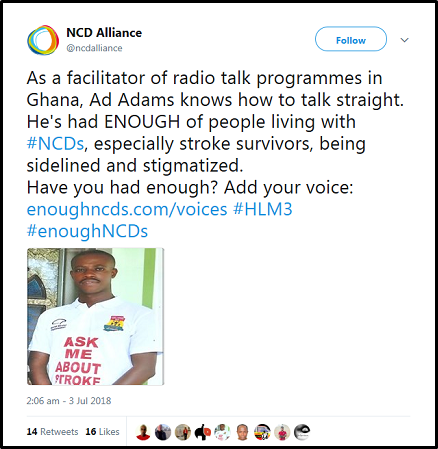
Ebenezer Adams has added his voice to the #enoughNCDS Campaign 


Read more about the Stroke Association Support Nework Ghana SSO Spotlight


Stroke on the agenda at the NCD Alliance Our Views, Our Voices Training Workshop


Jelka Jansa of the Stroke Support Organisation Slovenia tells us about the recent NCD Alliance Our Views, Our Voices Training Workshop


How did you get involved in attending the NCD Alliance workshop in Geneva?
NCD Alliance sent an open call for applications. I am an occupational therapist working in an acute neurological hospital and I have become familiar with patient support organisations both locally and internationally, especially in the field of stroke. Therefore I responded to the questions and have used my own perspectives of being a main carer for my mum. She has been a stroke survivor for more than 20 years and has now additional health problems, including dementia and problems with breathing.

What was the focus of the workshop and what were the topics that you discussed?
The focus of this workshop was to train people living with NCDs to become an advocate and spokesperson.

The objectives of the workshop were:
  • To become familiar with NCDs, the 2018 UN High Level Meeting, policy landscape and advocacy opportunities.
  • To increase knowledge on mechanisms of participation/forms of involvement
  • To develop communication skills leveraging personal stories to call for change
  • To develop advocacy skills to mobilise communities and call for change
  • To increase confidence in being a spokesperson and advocate for NCD prevention and control
  • To develop a menu of actions to take forward the Advocacy Agenda of People
  • Living with NCDs and take advantage of the UN High Level Meeting on NCDs
How does this work connect with the issue of stroke awareness, prevention and support?
It links together very well. First of all, 90% of strokes are linked to 10 avoidable risks, by joint actions, including people living with NCDs, professionals, and policy makers, it is more likely that national governments will take necessary actions to control stroke incidence. In 2016,there were almost 14 million incidences of first-time strokes worldwide (Global Burden of Disease 2016). Their access to acute treatment and long term support is not even around the globe. It is important to call on the UN to guide national governments to invest into stroke care. For example, in Slovenia, rehabilitation access is limited and there is no community follow up as there is no rehabilitation taking place in patients’ homes.

What are the actions for you or others to do after attending this workshop? 
Spread the word about  NCDs and the UN High-Level Meeting campaign called ENOUGH. And invite other NCD groups to become involved with the “Our Views, Our Voices”. Stay connected and participate at events taking place just before the July  and September meetings in New York. The virtual space, facilitated by the NCD Alliance, provides a Community of Practice on the Meaningful Involvement of People living with NCDs. It is open to anyone who is affected by NCD and is willing to collaborate:  https://communities.gcmportal.org/plwncd  

Who else attended and did you identify any common issues in relation to the health conditions you work on?
There were representatives from other NCDs from all over the globe. There are differences, depending on the region. For example, in Africa one of the major issues is raising awareness and access to primary care. In many other regions people are facing problems with pollution that has multiple impacts on human health. Finally, many diseases still carry stigma with them. However, the common bottom line is that people living with NCDs have the power to make change regardless of location. The governments need to take action for having healthier citizens.

How can other SSOs get involved in the work of the NCD Alliance and the run up to the High Level Meeting on NCDs in New York later this year?
To visit Our Views, Our Voices website at: https://ncdalliance.org/what-we-do/capacity-development/our-views-our-voices   and get involved.
To join https://communities.gcmportal.org/plwncd   to share their own opinions to be able to further the Advocacy Agenda of People Living with NCDs.


Thursday, July 5, 2018

WSO calls for Increased Efforts and Investment to Reduce Global Burden of Stroke

Statement of the World Stroke Organization (WSO)
for UN Civil Society Interactive Hearing July 5th 2018, NYC


In preparation for the UN High Level Meeting on NCDs in September 2018, WSO is participating in the Civil Society Hearing at the UN. The organization is calling for urgent and specific action to reduce the global burden of stroke as part of the global effort to address NCDs. Below is the formal statement that has been prepared for submission to the Hearing.

NCDs in general - and cardiovascular disease with its two main components heart disease and stroke - continue to increase worldwide. Over the last 25 years, stroke has become the 2nd cause of disability and the 2nd cause of death worldwide. The burden of stroke disproportionately affects individuals living in resource-poor countries, where essential services including prevention, acute treatment and rehabilitation are unavailable; or only available to those with financial resources required for access. Most survivors of stroke carry a lifelong burden of physical, cognitive, mental, and socio-economic consequences, which causes an immense individual burden and DALY loss. In 2016 stroke accounted for 116 million years of life lived with disability (DALYS).

The major burden of stroke is in low and middle-income countries and it will grow dramatically unless there is a massive scaling-up of relevant interventions. Given the impact of stroke across all countries and continents, everyone is threatened by stroke. Stroke causes paralysis of an arm, a leg or half of the body, may impair the ability to speak or to comprehend language and vision, and may eventually lead to dementia. Stroke is an avoidable tragedy for patients, families and societies, because stroke is largely preventable and treatable. A significant proportion of global NCD burden can be attributed to stroke. Global improvement will depend on increased awareness, widespread availability and access to quality stroke treatment, primary and secondary prevention, and long-term care.

Research evidence underscores the impact that addressing stroke could have on the achievement of SDG3.  90% of strokes are linked to a few key detectable and modifiable risk factors that include hypertension, smoking, obesity, physical inactivity, and unhealthy diet. These factors are essentially the same for ischemic heart disease, the other main cause of disability and death around the globe.

An under-recognized long-term consequence of stroke and other NCDs, such as heart failure, chronic kidney disease, diabetes and hypertension is the development of dementia, which is also preventable and in some instances even reversible. This neglected long-term consequence represents a further major global health burden. Stroke and dementia often occur together, pose risks for each other and share common risk factors. It can be assumed that a major part of dementias is, in principle, preventable through coordinated action to prevent these diseases.

The WSO calls upon member states to increase their efforts in three domains

1)     Awareness: Member States must strengthen programs that increase awareness of stroke symptoms, stroke risk factors and prevention, and the consequences of stroke.

2)      Access and implementation: We support WHO, NCD Alliance Partners and Member States in their efforts to remove financial barriers to prevention and detection of NCDs through universal health coverage and essential medicines and devices including stroke units and re-canalization treatment as an evidence based policy; this will allow for implementation of population-wide prevention strategies and access to acute stroke services.

3)      Action: We support the WHO and UN Member States in the development of regional and national strategies (such as the HEARTS package and the implementation of WSO Global Guidelines for Quality Stroke Care) to deliver the health-related Sustainable Development Goals, in particular for the reduction of premature NCD deaths by one-third by 2030.

Following the publication of WHO ICD 11 and the classification of stroke as a disease of the Nervous System, we strongly suggest that “stroke” as a distinct disease entity is made more visible in NCD discourse. While stroke has many of the same risk factors as heart diseases, we argue that it requires targeted action and policy responses that reflect the scale of the disease. More importantly, the symptoms of stroke, its treatments and its consequences are unique and sorely underrecognized by the public, adversely impacting access to appropriate treatment and patient outcomes. 

The close relationship between heart disease, stroke, hypertension, diabetes and chronic kidney disease supports the concept of the coalition for vascular health that the WHF, WSO, WHL and the diabetes and kidney societies, together with other stakeholders have created.

The magnitude of the associated health problems and the projected worldwide increase of all these conditions makes an even stronger argument for best practice in prevention and management of stroke and all other conditions which would lower premature mortality, DALYs and preventable dementia.

In summary, the WSO strongly supports all efforts to upscale actions in reducing the burden of NCDs and wants to point out that all actions should be seen as investments, not as cost.

There is much we can do immediately. The first biggest step is to give to stroke the visibility it requires. For many stroke is still summarized under ‘cardiovascular diseases’ but should from now on be correctly be considered and referred to as 'Heart Disease and Stroke’.

#stroke
#enoughNCDs

#HLM3

Monday, July 2, 2018

REPORT Educational Stroke Program in Brazil


Endorsed by World Stroke Organization 


The Ministry of Health of Brazil published on April 12th 2012 a national policy for stroke. The policy included the organization of stroke care in local networks integrating all points of care for stroke assistance (primary care professionals, pre-hospital Emergency Medical System and hospitals), development of stroke units, payment of tPA for the government and better reimbursement for stroke patients treated in stroke units.


To help the Ministry of Health implement this policy, we launched on June 20th 2012, an Educational Stroke Program, a partnership between the Brazilian Stroke Society, Brazilian Academy of Neurology, Brazilian Stroke Network, Brazilian Medical Association and the Ministry of Health and endorsed by the World Stroke Organization.

The educational program consisted of two sections; firstly an online component and secondly via a face to face meeting.


The lectures were prepared by stroke neurologists, based on international practice guidelines, and has trained all professionals linked to stroke assistance, including primary care professionals to improve primary and secondary prevention.

The online course is free.

Our online course trained more than 6000 doctors and 4000 other health professionals.


In 2017 we had several in person training:
* pre-hospital - SAMU (8)
* stroke centers (39)
* community hospitals (5)
* primary attention (2)
* neurologists (2)


Now in 2018 we are planning to renew the online lectures.


Dr Sheila Martins


Saturday, June 30, 2018

World Stroke Organization welcomes WHO stroke classification and definition in ICD 11


The World Stroke Organization has welcomed the recent release by the World Health Organization (WHO) of the ICD 11. The ICD is the global system for clinicians, administrators, and governments to report health statistics at all levels. 
In the newly released ICD 11, cerebrovascular diseases form a single block under diseases of the nervous system. This is a major change compared to the previous classification, in which stroke was placed under diseases of the circulatory system. Furthermore, the new ICD 11 provides precise definitions of stroke and other cerebrovascular diseases for global use. 
WSO works to improve stroke prevention, treatment and support globally. It represents over 50,000 stroke experts worldwide and hasadvocated for the change.  In welcoming the classification, Prof Werner Hacke, President of WSO said ‘By categorizing stroke correctly under diseases of the Nervous System, WHO is supporting global efforts by stroke professionals, survivors and carers to increase public recognition of stroke and to improve access to stroke treatment and care. Stroke is a leading cause of death and disability worldwide, accountable for 14m deaths and 116 DALYs in 2016.  We firmly believe that correct classification will help to save millions of lives and reduce the massive individual and global impact of stroke-related disabilities in years to come. With the world now focused on reducing the burden of Non-Communicable Diseases, this is a timely and important step.’
In recent years, opportunities to improve stroke outcomes have improved due to the development of effective acute stroke treatments such as thrombolytic therapy and thrombectomy. Access to effective acute therapies such as these are contingent upon the early recognition of symptoms from the brain and fast access to appropriately designed stroke treatment facilities with the appropriate neurovascular expertise. ‘Classifying stroke as a disease of the brain is important to facilitate awareness and early recognition, and reporting stroke accurately is instrumental to recognize the true burden of stroke among the spectrum of diseases.’ Said Prof Bo Norrving, Chair of the WSO Global Policy Committee, member of the ICD 11 neurology advisory group and Chair of the working group on cerebrovascular diseases.
Stroke and heart disease share most risk factors and several heart and circulatory conditions increase individual risk of stroke. Strokes and TIAs (mini-stroke) are also leading contributors to cognitive decline and dementia.
WSO will continue to prioritize clinical and public education on the linkages between stroke and heart disease, dementias and other Non-Communicable Diseases. The Organization already works in close partnership with the World Heart Federation and the World Hypertension League and partners in the wider non-communicable disease space as a member of the NCD Alliance and in the Coalition for Vascular Health. It will continue to advocate strongly for improved primary prevention policy to address common NCD risk factors, as well as for increased and more equitable access to screening and treatment for conditions including hypertension (high blood pressure), atrial fibrillation (irregular heartbeat) and hyperlipidemia (high cholesterol) all of which are specifically associated with higher stroke risk.


Monday, June 25, 2018

Stroke Foundation Uganda, a new WSO member, gives hope to stroke survivors and their families


1    


Ibrahim Bukenya is the founder and principal physiotherapist at the Stroke Rehabilitation Center, home to the Stroke Foundation Uganda, in Kampala. 

What has inspired you to be involved in stroke support?
The inspiration was when I had a challenge in taking care of a mother who had a stroke and later passed away and the fact that I had worked with the Stroke Rehabilitation Center for the last 8 years by then. There were challenges other stroke survivors were going through and Uganda’s burden of stroke is increasing every day. I want to help prevent people from going through this challenging condition, to minimise adult disability caused by stroke and to have a stroke free Uganda.

What does stroke support look like in your country?
Stroke support in Uganda is mainly about stroke survivors coming together and encouraging each other to reach a common goal which is recovery and to go back to work. The Stroke Rehabilitation Center helps the survivors who cannot afford the rehabilitation costs. Our stroke support groups have volunteers who go to visit the survivors to encourage them. The stroke support group organises the World Stroke Day event with different activities to help increase awareness.

How did the project come about?
The project came about after realising the challenges the stroke survivors go through and the       national stroke burden.                                                                                                                                                          
What have been some of the outcomes of the project?
About 2% of stroke survivors have recovered to 90% and gone back to work.
Stroke survivors who have attended stroke support groups and rehabilitation treatments are promoting our name across the country, thanking and talking good about giving them hope again and families have been saved from tearing apart due to the counselling given to both care givers and survivors.

What has been the response from others- community, doctor’s politicians?
In the community the mindset about stroke has changed from the witchcraft perspective to rehabilitation and seeking early treatment from hospitals rather than traditional healers.
Doctors are increasingly understanding how important rehabilitation is to the survivors and we are already collaborating with some of them from the primary health facilities, however, other doctors still think negatively that rehabilitation treatment is competition to their work.
Politicians are getting to understand rehabilitation treatment through the parliamentary health weeks and through their relatives that have attended the support groups.

Stroke can attack any one at any time affecting the economic viability of someone, therefore stroke awareness prevention should be taken so seriously by knowing the risk factors for stroke, the signs and symptoms and in case someone gets a stroke to rush the person to the nearest hospital.

For more information:


Monday, June 18, 2018

New ICD 11 stroke classification will support global efforts to improve prevention, treatment and outcomes


After sixty-two years of officially categorizing stroke as a Disease of the Circulatory System, the newly published WHO ICD 11, has correctly classified stroke as a Disease of the Nervous System. 

ICD 11 is a foundation document for health policy and treatment globally and the decision on stroke classification has been warmly welcomed by the World Stroke Organisation. WSO actively advocated for the change, arguing that positioning stroke as a disease of the brain will support global efforts to increase recognition of stroke and improve access to services and treatments that save lives and reduce post-stroke disabilities. Stroke was responsible for 14m deaths and 116 DALYS in 2016 alone, directing attention to the brain and what can be done to reduce premature deaths.

To find out more about why the WSO has made it a priority to achieve this change, I talked to Bo Norrving, Chair of the organization’s Global Policy Committee. Bo has also been chair of the Cerebrovascular Diseases group for the ICD 11 and is a member of the WHO Neurology Topical Advisory Group, chaired by Raad Shakir. 

Why does it really matter that stroke is classified as a brain disease, not a disease of the circulatory system – aren’t the two closely related?

It’s true that there are close links between cardiovascular disease and stroke; many risk factors are shared and primary prevention will target both disorders jointly.  We work closely with colleagues in the Non-Communicable Disease (NCD) and cardiovascular (CVD) sphere to advance our common prevention agenda. 

The simple fact, however, is that when strokes happen, they happen in the brain. 

Delivering stroke treatment early and efficiently with effective acute therapies such as thrombolytic therapy and thrombectomy, depends on the early recognition of symptoms from the brain and early actions to call an ambulance. This is why in many countries campaigns to increase public knowledge of stroke symptoms (like the FAST campaign) have been conducted. These campaigns are founded on in recognition that ‘time is brain’. Similarly, providing early treatment of transient ischemic attacks (TIAs), which are linked to stroke and are a significant contributing factor to dementia, depends on public awareness of the symptoms and rapid admittance to hospital. 

The impact of delivering effective treatment for acute stroke - and the opportunity to prevent a stroke - present huge opportunities to reduce the global burden of disease and cannot be missed if we are to are to achieve global goals on NCD reduction. Thinking beyond prevention, understanding the role of the brain in residual stroke symptoms and disabilities from stroke is critically important to providing patients with effective long-term rehabilitation and support.  

Classifying stroke under diseases of the circulatory system has kept stroke in the shadows where it couldn't easily be seen or dealt with.  We are delighted that this is no longer the case and that more light can be cast to the specifics of stroke and the opportunities we have to improve prevention and treatment.

How do you think this change will help with the achievement the global goal to reduce avoidable deaths from stroke? 

Stroke is the second biggest killer and the largest single cause of disability worldwide and yet still struggles to get the policy attention and resources commensurate with its global impact. Identifying stroke as a disease of the brain and pulling all types of cerebro-vascular diseases into a single block in the ICD 11 will, we believe, guide policy attention to the right place and enable us to develop 21st century services for stroke. 

Stroke is probably the best example there is of a non-communicable disease that is highly preventable and highly treatable. With the right focus and commitment to stroke we can make a massive impact on the achievement of global health and development goals .

Featured Post

Epidemiologic profiling for stroke in Nepal: Endeavour towards establishing database

Resha Shrestha  @avi_neuro. , MS 1 , Avinash Chandra, MD 1 , Samir Acharya, MS 1 , Pranaya Shrestha, MS 1 , Pravesh Rajbhandari, MS 1 , Re...